Steps to build a data warehouse: what you need to know
By Lee Nash
Steps to build a data warehouse: what you need to know
By Lee Nash
Understanding the steps to build a data warehouse is one of the most practical investments a finance team can make in its analytical capability. A well-designed warehouse draws together every data source the business relies on — general ledger, ERP, CRM, payroll, billing — into a single, query-ready environment where reports run in seconds rather than days. At Nash & Co, we help organisations work through exactly this challenge, and the projects that deliver lasting value share a common thread: they are treated as business initiatives, not IT deployments.
What a data warehouse actually does — and why it matters now
A data warehouse is a central repository that integrates structured data from multiple sources and organises it for analysis. Unlike an operational database, which is designed to process individual transactions quickly, a warehouse is optimised for reading large volumes of historical data and answering complex, multi-table queries at speed.
For finance teams, the practical payoff is clear. Month-end reporting that once required days of manual extraction, transformation, and reconciliation can run in minutes against a well-structured warehouse. Audit trails become cleaner. Budget-versus-actual analysis gets faster because the data is already prepared and consistently defined.
It is also worth distinguishing a warehouse from a data lake. A lake stores raw, unstructured data in its native format; a warehouse holds structured, transformed data that is ready to query. Many modern architectures use both — the lake as a staging area, the warehouse as the analytical layer that finance actually touches.
Cloud platforms have removed much of the cost and operational burden that once made data warehousing a large-enterprise technology. AWS Redshift, Google BigQuery, and Snowflake have each made it realistic for mid-market organisations to build serious analytical infrastructure — though as we at Nash & Co will always say, the platform is the least interesting part of the problem.
The core build phases, from discovery to go-live
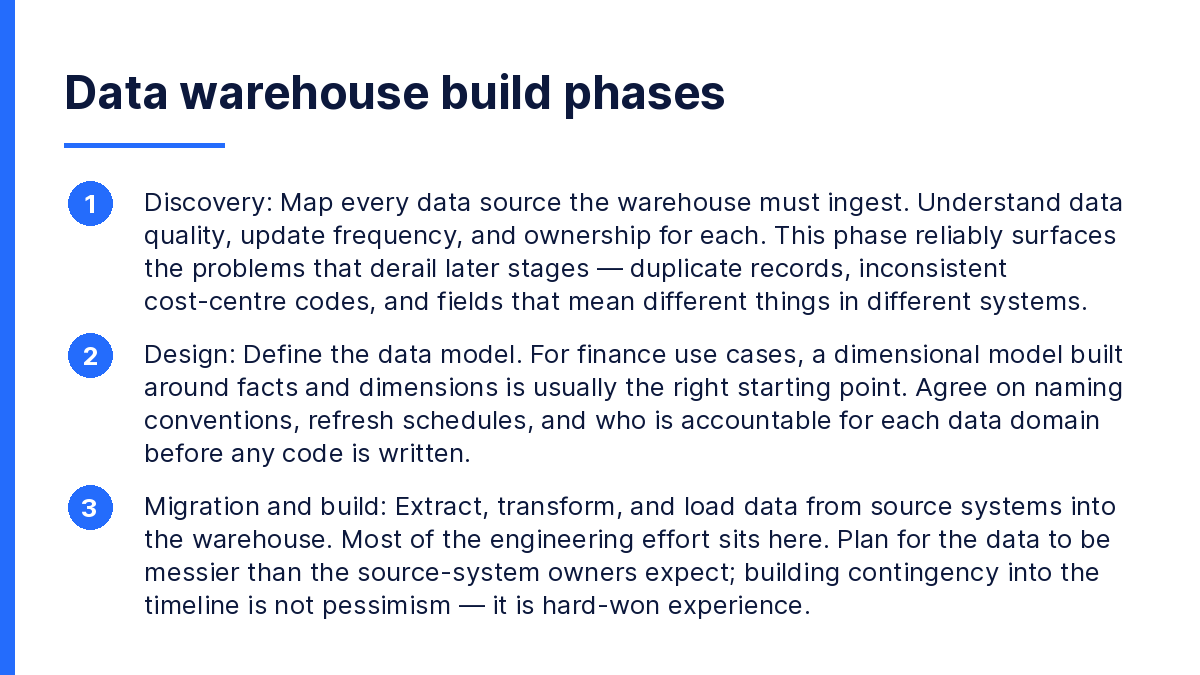
Every successful warehouse project follows a recognisable pattern. Scopes and timelines vary, but the four phases below provide a reliable framework.
- Discovery: Map every data source the warehouse must ingest. Understand data quality, update frequency, and ownership for each. This phase reliably surfaces the problems that derail later stages — duplicate records, inconsistent cost-centre codes, and fields that mean different things in different systems.
- Design: Define the data model. For finance use cases, a dimensional model built around facts and dimensions is usually the right starting point. Agree on naming conventions, refresh schedules, and who is accountable for each data domain before any code is written.
- Migration and build: Extract, transform, and load data from source systems into the warehouse. Most of the engineering effort sits here. Plan for the data to be messier than the source-system owners expect; building contingency into the timeline is not pessimism — it is hard-won experience.
- Go-live and iteration: Launch with a defined, tested scope rather than waiting for perfection. Establish a feedback loop with end users and iterate quickly. The first version of any warehouse is a starting point, not a finished product.
Governance needs to run across all four phases, not bolt on at the end. Define data access rights, document lineage, and assign ownership as you build — retrofitting these after the fact is far more expensive. Think of it as building compliance into the construction process, not inspecting for it at handover.
Choosing your platform and architecture
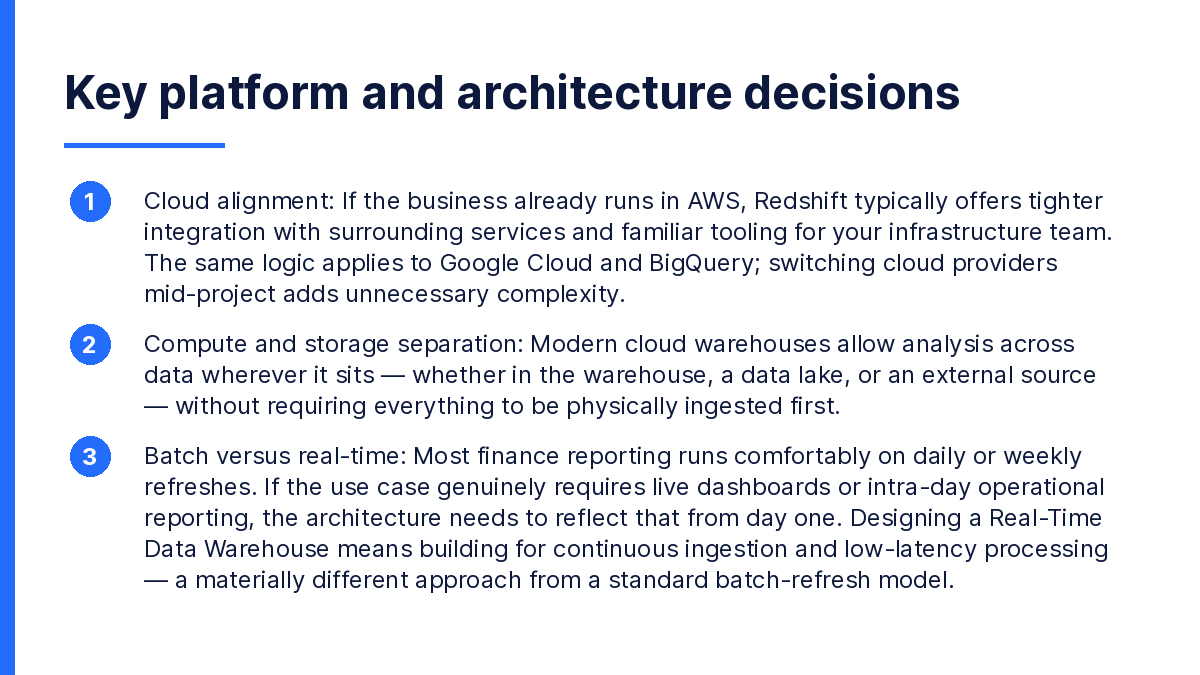
The right platform depends on your existing infrastructure, your team's skills, and the query patterns your analysts actually need. There is no universally correct choice, but three considerations consistently rise to the top.
- Cloud alignment: If the business already runs in AWS, Redshift typically offers tighter integration with surrounding services and familiar tooling for your infrastructure team. The same logic applies to Google Cloud and BigQuery; switching cloud providers mid-project adds unnecessary complexity.
- Compute and storage separation: Modern cloud warehouses allow analysis across data wherever it sits — whether in the warehouse, a data lake, or an external source — without requiring everything to be physically ingested first.
- Batch versus real-time: Most finance reporting runs comfortably on daily or weekly refreshes. If the use case genuinely requires live dashboards or intra-day operational reporting, the architecture needs to reflect that from day one. Designing a Real-Time Data Warehouse means building for continuous ingestion and low-latency processing — a materially different approach from a standard batch-refresh model.
The mistakes that cost teams the most
Data warehouse projects fail for predictable reasons. Knowing them in advance makes them avoidable.
Underestimating data quality work. Source systems accumulate inconsistencies over years. Surfacing and resolving those takes real effort. Teams that skip this step build a warehouse on shaky foundations and spend months debugging reports that refuse to reconcile.
Scoping too broadly at the start. An ambitious first phase that attempts to ingest every system at once almost always stalls. Starting with two or three high-value data sources — typically the general ledger and one operational system — and proving the model before expanding is consistently more effective.
Treating transformation as an afterthought. The ETL process is where raw data becomes reliable, analysis-ready information. Failing to standardise date formats, currency codes, or entity names creates a warehouse that looks functional but produces subtly wrong answers. Transformation logic should be version-controlled and tested like any other production code.
Neglecting the consumer. The warehouse only has value if finance analysts can use it confidently. That means choosing the right reporting layer, training users properly, and producing documentation that survives staff turnover. A finance team that cannot self-serve basic reports without raising a ticket with IT will quickly lose faith in the new environment.
No clear ownership post-launch. A warehouse that nobody is accountable for maintaining degrades quickly. Assign a named data owner for each domain before go-live, and make the maintenance responsibility explicit.
Key Takeaways
- A warehouse project succeeds or fails in the discovery phase; invest time in understanding your source data before writing transformation code.
- The four phases — discovery, design, build, and go-live — provide reliable structure, but governance and data quality work must run across all of them.
- Platform choice is secondary to getting the data model and ownership model right from the start.
- Launch with a narrow, well-tested scope and iterate; attempting to deliver everything at once is a reliable route to delay.
- Real-time requirements demand a fundamentally different architecture; confirm whether you genuinely need them before designing for them.
If your organisation is considering consolidating its finance data into a single, reliable reporting environment, Nash & Co can help. We would be glad to discuss what that looks like in practice — reach us at lee@nashco.co.uk or visit www.nashco.co.uk.
Sources 1. Designing a Real-Time Data Warehouse — SingleStore 2. Learn to build a data warehousing solution — AWS Training & Certification 3. Data Warehouse Implementation — Digital Marketplace 4. Introduction to data warehouses: use cases, design and more — RST Software